


Revolutionizing Document Interface Development
Modern productivity software has come a way from simple text editors. Users now want collaborative and feature-rich environments that connect structured databases and free-form documents. Building these interfaces from scratch is a time-consuming task. Developers often have to recreate components like block editors slash commands and real-time collaboration widgets. Extend UI is a game-changing solution that offers a open-source kit for developers building collaborative document-centric applications.
With Extend UI teams can skip the repetitive work of creating basic UI elements. This allows them to focus on what makes their software unique. The toolkit is built with web standards in mind. It is also flexible enough to work with existing custom design systems. The goal of Extend UI is to make high-quality UI accessible to both developers and large teams.
The Architecture of Extend UI
Extend UI is designed to handle the challenges of document-based systems. Unlike component libraries it focuses on performance and modularity. Each component is lightweight. This ensures that complex documents with interactive blocks remain fast. The library uses an approach. It provides the logic and functionality for document features. Developers have control over the final visual presentation.
This design is crucial for teams with strict branding guidelines. Developers can easily change styles. Extend existing components. They do not have to fight against a framework. By providing a foundation and clear APIs Extend UI helps frontend teams. It enables them to build features much faster.
Implementing Core Components
Integrating Extend UI into a project is straightforward. Its modular design makes it easy to use. Developers can import the components they need. This avoids bloat. The library offers interfaces. These interfaces feel familiar to developers who use React or Vue.
For example initializing a document block component is simple. Here is an example:
import { DocumentBlock, BlockEditor } from '@extend-ui/core';

function MyDocument() {
  return (
    <BlockEditor>
      <DocumentBlock type="text" content="Welcome to your document." />
      <DocumentBlock type="image" src="header.jpg" />
    </BlockEditor>
  );
}
This level of abstraction helps developers focus on the application state and business logic. They do not have to spend weeks perfecting content blocks. The library documentation provides examples for use cases. These include drag-and-drop reordering and real-time multiplayer cursors.
Designing for Modern Collaboration
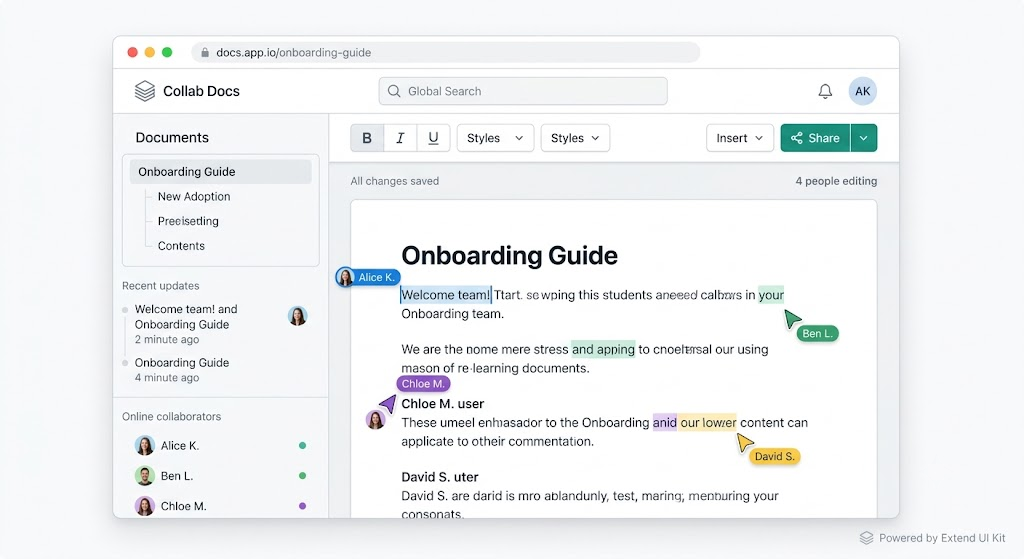
Modern document apps are all about real-time collaboration. Extend UI recognizes this. It includes hooks and primitives for environments. By working with libraries like Yjs or Automerge the components simplify state management for editing. This ensures that changes are reflected across all clients with minimal delay.
The components also have built-in accessibility features. These ensure that shared documents are usable for everyone. The library adheres to ARIA standards. Provides robust keyboard navigation support. This helps teams maintain standards for user experience and inclusivity.
Contributing to the Ecosystem
As an open-source project Extend UI needs community participation. Developers can contribute by reporting issues submitting pull requests or developing plugins. The maintainers emphasize a development process. They ensure that the roadmap aligns with the needs of the community. The documentation includes a guide on building custom block types that integrate with the existing architecture.
By fostering a community of shared knowledge the project aims to become the UI library for document-based applications. Extend UI provides the building blocks, for success in a competitive market. Engaging with this ecosystem accelerates development cycles. It also connects developers with a community of engineers focused on solving challenges.
Related Stories
I Tried De-Googling My Phone Just Two Apps Survived
I figured it was time. Time to really see if a life without Google on my phone was…

Apple Updates Beats Buds to Address Critical Privacy Vulnerability
Apple has patched a critical Bluetooth security vulnerability in Beats Studio Buds that could have allowed unauthorized users…

The Ad Blocker That Advertised Itself to Me on a Pirate Streaming Site
The pitch came, of all places, in the middle of the exact kind of website it was built…