


Creating a Book Pipeline with Git Without Using Adobe or Microsoft
When it comes to making books people often use tools like Adobe InDesign and Microsoft Word. However these tools have some problems, especially when it comes to working with others and keeping track of changes. Git is a system that helps people work together on projects and keep track of changes. We can use Git to make a way to produce books. This article will show you how to make a book pipeline using Git without using tools like Adobe and Microsoft.
Why Not Use Adobe and Microsoft?
Tools like Adobe InDesign and Microsoft Word are powerful but they have some big problems. They do not handle changes well which makes it hard for multiple people to work on a project at the time. Also these tools can be expensive. May not work well with modern workflows that use automation and scripting. Git on the hand is made for working together. It lets multiple people work on a project at the time keeps track of changes and shows a clear history of what happened. By using Git you can make the book production process easier reduce mistakes and get things done faster.
Git is a good tool for book production because it helps people work together. Book production with Git is easier because Git tracks all the changes. This means that if something goes wrong you can easily go back to a version. Git also helps people work together on a book project. Multiple authors and editors can work on the book project at the same time without causing problems.
Setting Up a Book Pipeline with Git
To start making a book pipeline with Git you need to set up a Git repository. This repository will hold all your book files, including text, images and other information. Here is how you can start:
- Make a New Git Repository: Create a folder for your book project and make a new Git repository using the command
git init. - Make a.gitignore File: This file tells Git which files and folders to ignore. For example you might want to ignore files or files that are made when you build your project.
- Add Your Book Files: Put all the necessary files into your repository, such as chapters written in Markdown or LaTeX images and configuration files.
- Save Your Changes: Use
git addto get your files ready andgit committo save your changes to the repository.
Choosing the Right File Formats for Your Book
When making a book pipeline with Git it is very important to choose the right file formats. Unlike the formats used by Adobe and Microsoft open formats like Markdown and LaTeX are great for version control. These formats are text, which makes them easy to read edit and track changes in Git. Book production with Git is easier when you use these formats.
Markdown is a choice for writing because it is simple to learn and use. It is also widely. Can be easily changed into other formats like HTML or PDF. LaTeX is great for documents with math or special layouts. Git and these formats work well together to make book production easier.
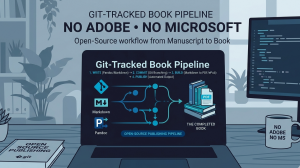
Automating the Build Process for Your Book
One of the things about using Git for book production is that you can automate the build process. Of manually putting your book together every time you make a change you can use scripts to do it for you. Here is an example of a script to change Markdown files into PDF:
#!/bin/bash

# Change all Markdown files to PDF using Pandoc
for file in *.md; do
    pandoc "$file" -o "${file%.*}.pdf"
done
This script uses Pandoc a tool that can change many types of files to turn Markdown files into PDFs. You can add this script to your Git workflow so every time you save changes the PDF is automatically made again.
Working with Others on Your Book Using Git
Git is very good at helping people work together. Multiple authors and editors can work on the book at the same time without causing problems. Here is how you can use Git to work with others:
- Make Branches: Create branches for different parts of the book. This lets contributors work alone without interfering with each other.
- Use Pull Requests: Use pull requests to look at and combine changes. This makes sure that all changes are checked before they are added to the branch.
- Track Issues: Platforms like GitHub and GitLab have tools to track issues, which can be used to manage tasks find mistakes and ask for new features.
Integrating with Continuous Integration for Your Book
To make your book production pipeline even better think about integrating Git with a Continuous Integration system. Continuous Integration systems like GitHub Actions or GitLab CI can automatically run scripts whenever changes are added to the repository. For example you can set up a pipeline to:
- Change Markdown files to PDF.
- Check for spelling and grammar mistakes.
- Put the version of the book on a web server.
Here is an example of a GitHub Actions workflow to automate changing Markdown to PDF:
name: Build Book

on:
  push:
    branches: [ main ]

jobs:
  build:
    runs-on: ubuntu-latest
    steps:
 . Uses: actions/checkout@v2
 . Name: Convert Markdown to PDF
      run: |
        sudo apt-get install -y pandoc
        for file in *.md; do
          pandoc "$file" -o "${file%.*}.pdf"
        done
 . Name: Upload PDFs
      uses: actions/upload-artifact@v2
      with:
        name: book-pdfs
        path: *.pdf
Benefits of a Book Pipeline with Git
By not using traditional tools like Adobe and Microsoft and instead using a book pipeline with Git you get several benefits:
- Version Control: Every change is tracked so you can go back to a previous version if you need to.
- Working Together: Multiple people can work on the same project at the same time without problems.
- Automation: You can automate tasks like changing files or putting updates on a server.
- Cost-Effective: Open-source tools are often free or cheaper than proprietary software.
In the end making a book pipeline with Git offers a modern, efficient and collaborative way to produce books. By using Git and open-source tools you can avoid the limitations of software and make a workflow that is both powerful and flexible.
For more information, on modern book production techniques check out this detailed guide.
Related Stories

GitHub’s Take on Age Assurance for Developers and Platform Safety
GitHub is redefining developer safety through age assurance, balancing strict global regulations with privacy-centric identity verification for the…

Technical Analysis: Measuring Spatial Capacity in Code
Explore an in-depth analysis of the technical insights and geometric principles presented in On the Calculation of Volume…

FCC Evaluates Ending $2B Fund for School and Library Connectivity
The FCC may terminate a $2 billion program providing internet connectivity to schools and libraries, risking a major…